
Comparison
Polyurea vs Polyaspartic: What Is Actually on Your Garage Floor?
Updated October 2026 · Garage Force of the Inland Northwest, Spokane Valley, WA
Quick answer
Polyurea and polyaspartic are related coating chemistries, and floor coating ads use the two names loosely, sometimes for the same product. What matters more than the label is what goes down in each layer: the base coat, the chip and the topcoat, and how the slab is prepped under them. Garage Force of the Inland Northwest installs CycloSpartic, a polyurea based system, and does not offer separate polyaspartic or epoxy floors.
- Veteran owned and local
- Licensed and bonded in WA and ID
- Transferable lifetime warranty
The problem: two quotes, same word, different floors
Homeowners comparing quotes often see polyurea on one, polyaspartic on another, and polyurea polyaspartic on a third. It is hard to tell whether those are the same floor. Often they are not, and the label alone will not tell you.
Why the names get confusing
Polyaspartic coatings are a slower reacting branch of the polyurea family, which is why the phrase polyaspartic polyurea exists. Some companies call a polyaspartic floor polyurea, and some do the reverse. Many systems also mix chemistries, like an epoxy base coat under a polyaspartic topcoat.
So a quote that only says polyurea, or only says polyaspartic, has not told you much. Ask what each layer is.
What CycloSpartic is
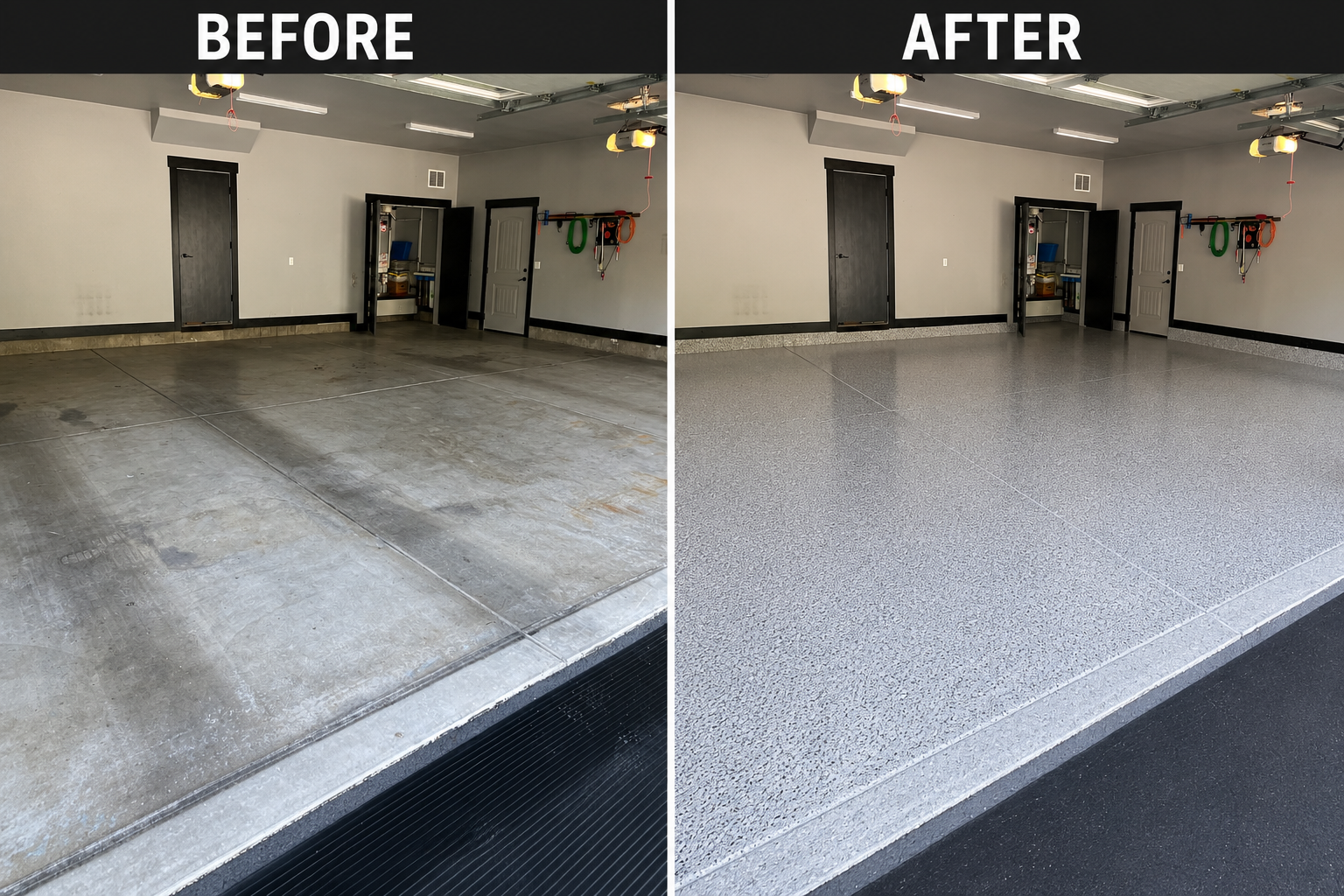
CycloSpartic is Garage Force's own coating system, which the owners describe as a polyurea product. Garage Force of the Inland Northwest does not sell a separate polyaspartic floor. It goes down as a full broadcast chip floor: a mechanically prepped slab, a polyurea base coat, color chip across the whole floor, and a clear topcoat. Most two car garages are done in one day, and the floor carries a transferable lifetime warranty.
Questions that cut through the labels
The full list of questions, including licensing and who shows up, is in the contractor checklist.
- 1What is the base coat, by product name?
- 2What is the topcoat, by product name?
- 3How many coats go down, and is chip broadcast across the whole floor?
- 4How is the slab prepped? Mechanical prep, or etching and washing?
- 5What does the warranty cover in writing, and does it transfer if you sell?
What a floor here has to do, whatever it is called
Epoxy struggles on the first and third points. See polyurea vs epoxy.
- Flex with the slab through freeze thaw cycles instead of cracking.
- Keep road brine, oil and snowmelt on the surface.
- Cure in the cool temperatures of spring and fall.
- Bond into mechanically prepped concrete, not sit on top of it.
Get your exact price
Answer three quick questions, pick a time, and get a free on-site estimate. Free and on site with the owners.
Frequently asked questions
Is polyaspartic better than polyurea?
The label does not settle it, because the two names are used loosely. Ask what goes down in each layer and how the slab is prepped. Garage Force installs polyurea only.
Is CycloSpartic a polyaspartic coating?
It is Garage Force's own polyurea based system, not a standard polyaspartic product, installed as a full broadcast chip floor. Ask the owners for the product data sheet if you want the chemistry layer by layer.
Is polyurea the same as epoxy?
No. Epoxy is a different, more rigid chemistry that needs a warmer slab to cure. Garage Force does not install epoxy.
Why do some companies say polyurea polyaspartic?
Because polyaspartics belong to the broader polyurea family. The phrase is accurate chemistry, but it still does not tell you what is in each layer of your floor.